Short answer Shortlist firms whose live work you can open and test on your own phone. Ask who will actually build your site, and get quotes that list pages, features, content and exclusions. Insist the domain, hosting and code are in your name, with copyright assigned in writing. Walk away from anyone guaranteeing Google rankings.
Bengaluru has no shortage of web design companies. The hard part is comparing them fairly. This guide covers what we'd check if we were hiring someone else.
What should you check before shortlisting a web design company?
Live work, not screenshots. Ask for URLs of sites they built and open them on your phone, on mobile data. Do pages load quickly? Do the forms work? Does the WhatsApp button open a chat? A footer credit linking back to the studio helps you confirm who built what. The BS Desai artist site, for example, carries ours.
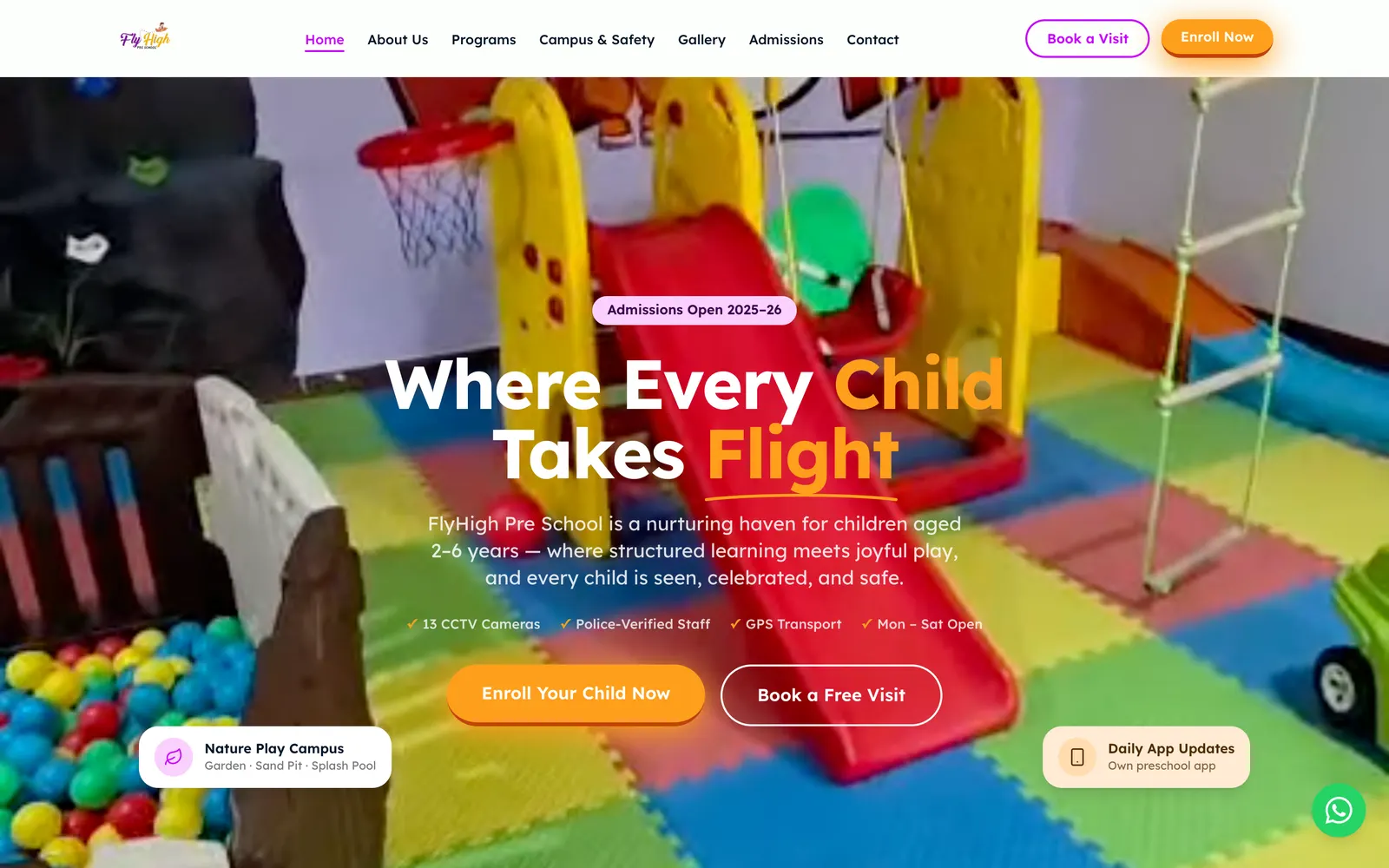
Work that resembles your problem. A preschool, a manufacturer and a shop need different things. The FlyHigh Pre School site needed admissions enquiries, campus-safety information, and privacy, terms and child-protection policy pages. The Sri Manjunatheswara Industries site needed to show tooling work and get enquiries from buyers. Ask for examples close to yours.
A past client you can call. Five minutes with a previous client tells you more than any case study.
Who does the work. In a small studio, the people who pitch are often the people who build. In a large agency, ask whether your project will be subcontracted.
What questions should you ask a web design agency?
Google's own guide to hiring an SEO suggests asking for examples of previous work, the results they expect and in what timeframe, their experience in your industry and city, and how you'll communicate (Google Search Central). The same questions work for a web design company. Add these:
- Who will design and build my site, and who do I talk to day to day?
- Is the design custom, or based on a theme? If a theme, which one, and who holds the licence?
- Who writes the text and supplies photos? Is that priced in?
- How will I edit content after launch?
- What will you set up for search: page titles, a sitemap, structured data, redirects from my old site?
- Where will it be hosted, in whose name, and what does renewal cost?
- What happens if something breaks a month after launch?
- What do I receive at the end: source code, logins, documentation, a copyright assignment?
- How are payments split across milestones, and is GST included?
Who owns the website, code and domain?
This is the question most buyers skip, and the one that hurts most later.
Copyright in the code and design. Under Section 17 of the Copyright Act, 1957, the author of a work is its first owner. The employer becomes the owner only for work made "under a contract of service", which means employees, not an outside agency you've hired. Section 19 says an assignment of copyright isn't valid unless it's in writing and signed. If the assignment doesn't state a period, it's deemed to be five years. If it doesn't state a territory, it's presumed to cover India only (Copyright Act, 1957, India Code). So ask for a written assignment of the custom work that states it's perpetual and worldwide. This is general information, not legal advice. Have a lawyer read the contract.
Third-party parts. Themes, plugins, fonts, stock photos and code libraries are licensed, not owned. Ask for a list of what's used and under which licence.
The domain. Register it in your business's name, with your email address. For .com and other generic domains, ICANN's Transfer Policy gives the registered name holder the authority to approve a move to another registrar, and if you can't retrieve the transfer code yourself, the registrar must provide it within five calendar days of your request (ICANN). If the agency is the registrant, you're asking their permission to leave.
Hosting and services. When we handed over the cbee app, the client received complete source code matching the shipped build, along with architecture, operations and handover documents. The handover listed every service, from the app store account to the database, DNS and web hosting, and each one was already in the client's own account. The one item not in a client account was the Android signing key, which sat on the developer's machine, so the document spelled out how to transfer it securely and back it up. That's the standard to ask for.
What are the red flags when hiring a web developer?
| Red flag | Why it matters |
|---|---|
| "Guaranteed #1 on Google" | Google says "No one can guarantee a #1 ranking on Google" (Google) |
| Domain or hosting in the agency's name | You need their cooperation to move, renew or change anything |
| Portfolio of screenshots, no live links | You can't check speed, mobile layout or whether the site still exists |
| No written scope | Every change becomes a negotiation |
| Nobody can say who builds it | Your project may be passed to someone you've never met |
| Quote with no renewal prices | The bill arrives in year two |
| Nothing about code, logins or copyright | You may not own what you paid for |
| Paid SSL or "search engine submission" | Both are free for a normal business site |
How do you compare website quotes?
Send every agency the same short brief, and ask each to fill in the same table. Then compare line by line, not total by total.
| Line item | What to pin down |
|---|---|
| Pages and page types | How many unique layouts, not only page count |
| Design | Custom or theme; number of revision rounds |
| Content | Who writes, photographs and translates |
| Features | Forms, WhatsApp, payments, booking, content editing |
| Search setup | Titles, sitemap, structured data, old-URL redirects, analytics |
| Hosting and domain | In whose name; year-one and renewal prices |
| After launch | Warranty period; maintenance scope and price |
| Handover | Source code, logins, documentation, copyright assignment |
| Payment terms | Milestones; GST inclusive or extra |
A quote that looks cheap often excludes content, renewals or support. Our breakdowns of what a website costs in Bangalore, maintenance costs and yearly running costs show what each line usually adds.
Freelancer, small studio or large agency?
Each can do good work. A freelancer suits a small, well-defined site where you're comfortable managing the details. A small studio suits projects that need design, development and search working together, with the people you meet doing the work. A large agency suits organisations that need many specialists, formal processes and account management. Pick based on your project, not the logo.
We're a founder-led studio in Chandra Layout, Bengaluru, covering web design, web development and SEO. If you'd like to put us through these questions, send us your brief and ask us anything on this list.