Short answer Published prices for a school or preschool website in India run from about ₹25,000 for a simple CMS build to over ₹1,80,000 for a custom design, and some vendors charge ₹40,000–₹70,000 a year instead. Running costs are small: a .in domain and shared hosting cost a few thousand rupees a year. Scope and content decide the rest.
We don't publish Spurt Studios prices in this post; every quote we give is fixed per project. What follows are the ranges other firms publish, the running costs from providers' own price pages, and our view on where a preschool's money actually earns something. For what the site itself should contain, see our preschool website checklist.
How much does a preschool website cost in India?
There is no survey of preschool website prices in India that we trust. What exists are price guides published by vendors. They are useful as the market's asking prices, not as a benchmark of quality.
| Source | What it covers | Published range |
|---|---|---|
| GoDaddy India guide (updated 2 April 2026) | A website on a content management system, any sector | ₹25,000 to ₹2,00,000 |
| SkoolReady (October 2024) | Template-based school site with gallery, news, curriculum | ₹40,000 to ₹70,000 a year |
| SkoolReady, same page | Adds online applications, calendar, more customisation | ₹70,000 to ₹1,20,000 a year |
| SkoolReady, same page | Custom-designed school website | Over ₹1,80,000 |
- Priced per year
- Period not stated
A fading end means no upper limit is published.
From the table above. Some prices are yearly and some are not labelled, which is why the bars are coloured by period. SkoolReady's top band is "over ₹1,80,000".
Two things to notice. First, some prices are one-time and some are yearly. A ₹50,000-a-year plan costs more than a ₹1,20,000 one-time build within three years. Second, the ranges are wide because "a website" hides very different amounts of work. The next section is where that work goes.
What drives the cost of a preschool website?
These are the items that move a quote up or down, roughly in order of how much they matter for a preschool.
| Cost driver | Why it adds cost | Worth it for a preschool? |
|---|---|---|
| Photography and video | A shoot day, editing, compression for mobile | Yes. Real photos are the strongest trust signal you have |
| Copywriting | Admissions, programmes, safety and policy pages take real drafting | Yes, unless someone at the school writes well and has time |
| Custom design vs template | Custom means designing each page type from scratch | Depends. A well-used template beats a weak custom design |
| Number of page types | Each distinct layout is designed, built and tested | Keep to what parents need; ten pages covers most schools |
| Enquiry form, WhatsApp, analytics | Form handling, spam protection, event tracking | Yes. This is how the site pays for itself |
| Legal pages and consent | Privacy, child-protection and photo-consent wording | Yes. The DPDP Rules make this non-optional (see below) |
| Second language | Doubles the content work, and done well needs separate pages per language | Only if your parents search in that language |
| Motion and animation | Scroll effects and transitions take build and testing time | Small doses only; it must not slow the phone |
| Online admission forms or fee payment | Moves the project from website to software | Rarely at launch |
| Parent portal or app | A separate product with logins, data and support | Not at launch for most preschools |
| Ongoing updates | Someone has to change dates, fees and photos every term | Yes, budget time or money for it |
On legal pages: the government notified the DPDP Rules on 14 November 2025 with an 18-month phased timeline. The PIB summary says verifiable consent from a parent or guardian is required when a child's personal data is involved, with exemptions for essential services such as education or real-time safety. A preschool website collects parents' details and shows children's photos, so the privacy policy and consent process belong in the scope from the start.
What does a full preschool website include?
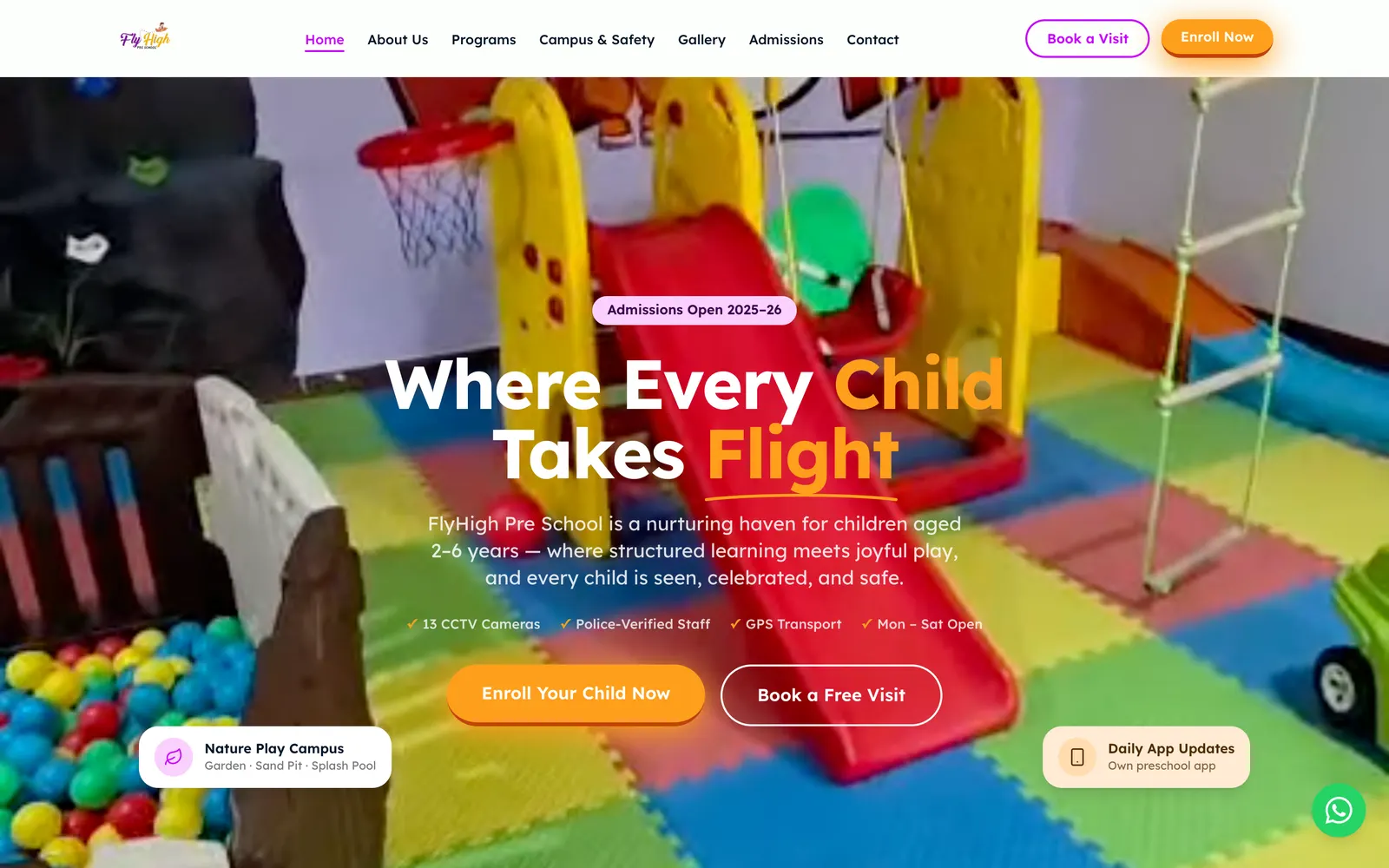
For scale, here is what we built for FlyHigh Pre School in Bengaluru. We won't share the fee, but the scope shows what a complete site for a single-campus preschool involves:
- Ten pages: home, about, programmes, admissions, campus and safety, gallery, contact, privacy, terms and a child-protection policy.
- An admissions page with age criteria, a four-step process, documents list, fee inclusions and FAQs.
- A safety page with six named measures, each with a real photo.
- A filterable photo gallery with a lightbox, and a home page hero video.
- An enquiry form (parent, phone, email, child's age, programme) and a WhatsApp button with a pre-filled message.
- Per-page titles and canonical URLs, a sitemap, structured data for the school and each programme, and analytics.
- A performance pass so the pages load quickly on phones.
If a quote for your school lists far less than this, ask which of these items you'll be doing yourself.
What's worth paying for on a preschool website?
Spend on the things that change a parent's decision:
- Real photos. Classrooms, the play area, the first-aid room, annual day. No stock images.
- An admissions page that answers everything. Ages, dates, steps, documents, what the fee covers.
- A specific safety page. Named measures, not adjectives.
- Speed on a phone. In a Google-commissioned study by Deloitte and 55 across 37 European and American brand sites, a 0.1-second improvement in mobile speed went with a 21.6% rise in lead-generation visitors reaching the form submission page (web.dev case study). Those were large brands, not preschools, but the direction holds for any site that lives on enquiries.
- An enquiry path that reaches a person. A short form, a phone number that gets answered, WhatsApp.
Hold back on:
- A parent app or portal. Build it later, if WhatsApp stops coping. That's a custom software project, not a website line item.
- Heavy animation. It costs build time and phone battery.
- A blog nobody will update. An empty news section from 2024 looks worse than none.
- Paying extra for "FAQ schema" to get rich results. Google stopped showing FAQ rich results on 7 May 2026 (Google's documentation updates). FAQs are still good content; they just don't earn a special search listing.
What are the yearly running costs?
These are the costs that recur after launch. Figures are from Hostinger India's own pages as of 29 September 2026, which state prices without GST; other providers are comparable.
| Item | Typical cost | Watch out for |
|---|---|---|
| .in domain | ₹899 a year at regular price (domain pricing); first-year offers as low as ₹1 | Register it in the school's name, not the vendor's |
| Shared hosting | Promotional ₹69–₹149 a month on a 48-month prepay; renews at ₹289–₹449 a month | Renewal is several times the promo price |
| Business email | Billed per user per month by Google Workspace, Zoho and others | Only pay for the addresses you use |
| Form service, if you use one | Some charge by monthly submission volume | Check the limit, and make sure enquiries reach a phone, not just an inbox |
| Content updates | Your staff's time, or a maintenance plan | Fees and admission dates change every year |
The domain and hosting together are a few thousand rupees a year. The real running cost is keeping the site true: this year's dates, this year's photos.
Template, builder or studio: which should a preschool choose?
| Option | Upfront | Who does the work | Fits when |
|---|---|---|---|
| DIY builder | Low monthly subscription | School staff | One campus, a confident writer on staff, tight budget |
| Template set up by a freelancer | Low to moderate | Freelancer builds; school supplies content and photos | You have content ready and need it online quickly |
| Studio build | Higher | Studio handles design, build, photos and copy direction | You want custom design, strong content and someone accountable after launch |
None of these is wrong. A preschool with a great DIY site beats one with an expensive site nobody updates.
How to compare preschool website quotes
Ask every vendor the same questions, in writing:
- Is the price one-time or yearly? What renews, when, and at what price?
- Whose name are the domain and hosting in?
- Are photography, copywriting and legal pages included, or do we supply them?
- How many pages and page types, and how many rounds of changes?
- Where do enquiries go, and how fast will we see them?
- Who updates fees, dates and the gallery after launch, and what does that cost?
- Do we own the site's content and code if we move to another vendor?
- Will we get access to analytics and Google Search Console?
Clear answers to those tell you more than the headline price.
If you run a preschool in Bengaluru and want a fixed quote, see how we work with preschools and schools, or read about our web design and web development services.
Sources
- GoDaddy India: How much does it cost to build a website in India (updated 2 April 2026)
- SkoolReady: School website design and development cost in India (October 2024)
- Hostinger India: web hosting and domain prices (checked 29 September 2026)
- Press Information Bureau: DPDP Rules, 2025 notified (17 November 2025)
- web.dev: Milliseconds make millions
- Google Search Central: Documentation updates