Short answer Choose by project, not by label. A freelancer suits a small, well-defined site you are happy to manage. A small studio suits a site that also needs development, search and ongoing care. A large agency suits organisations that need many specialists. Whoever you pick, check who does the work, who holds the logins and what you receive at handover.
Most people comparing a web design agency with a freelancer in Bangalore are really asking one thing: who will be accountable when the site is late, broken or needs changing a year from now? This guide gives you a way to decide. We are a founder-led studio, so we have a view. But we will tell you when a freelancer is the better choice, because for some projects they are.
For the full buying checklist, including copyright and quote comparison, read our guide to choosing a web design company in Bangalore. This post is the narrower question of what size of provider to approach.
What is the real difference between a freelancer, a small studio and a large agency?
The labels hide more than they show. The useful differences are these.
| Freelancer | Small studio | Larger agency | |
|---|---|---|---|
| Who does the work | One person, usually the person you meet | The people who pitch are often the people who build | Often a team behind an account manager; ask if any is subcontracted |
| Range of skills | Strong in one or two areas; may bring others in | Design, development and search under one roof | Many specialists |
| Continuity | Depends on one person | A few people know your site | Process and documentation, if followed |
| Speed to start | Often quick | Usually quick | Often slower, with formal onboarding |
| Management effort for you | Higher: you coordinate the pieces | Moderate | Lower for you, with more layers between you and the work |
| Best for | A small site with a defined scope | Sites that need design, build and search working together | Large organisations with formal procurement |
None of these is better in general. A preschool with ten pages and a clear idea of what it needs has different requirements from a company replacing a slow WordPress site and wanting it found on Google and by AI assistants.
When is a freelancer the right choice?
A freelancer is a good fit when most of these are true:
- The site is small, and you can describe the pages you need.
- You already have the content and photographs, or you will supply them.
- You are comfortable coordinating, for example finding someone separately for hosting, search setup or copywriting.
- You have seen live sites they built and tested them on your own phone.
- You can name a second person who could take over the logins if needed.
If that is you, a good freelancer will probably serve you well, and you may enjoy working one to one. Do not let anyone talk you into more than you need.
When does a studio or agency make more sense?
Look at a studio or agency when the project has several moving parts that have to fit:
- Design, development and search planned together. Page titles, structure, structured data and old-URL redirects are easier to get right when the person building the pages also thinks about search.
- Something beyond a brochure site. Logins, a catalogue, bookings, a dashboard or billing are software, and software needs testing and documentation.
- Continuity matters. If the site is central to how customers find and contact you, you want more than one person who understands it.
- Content has to be produced. Writing, photography and translation add up quickly if nobody owns them.
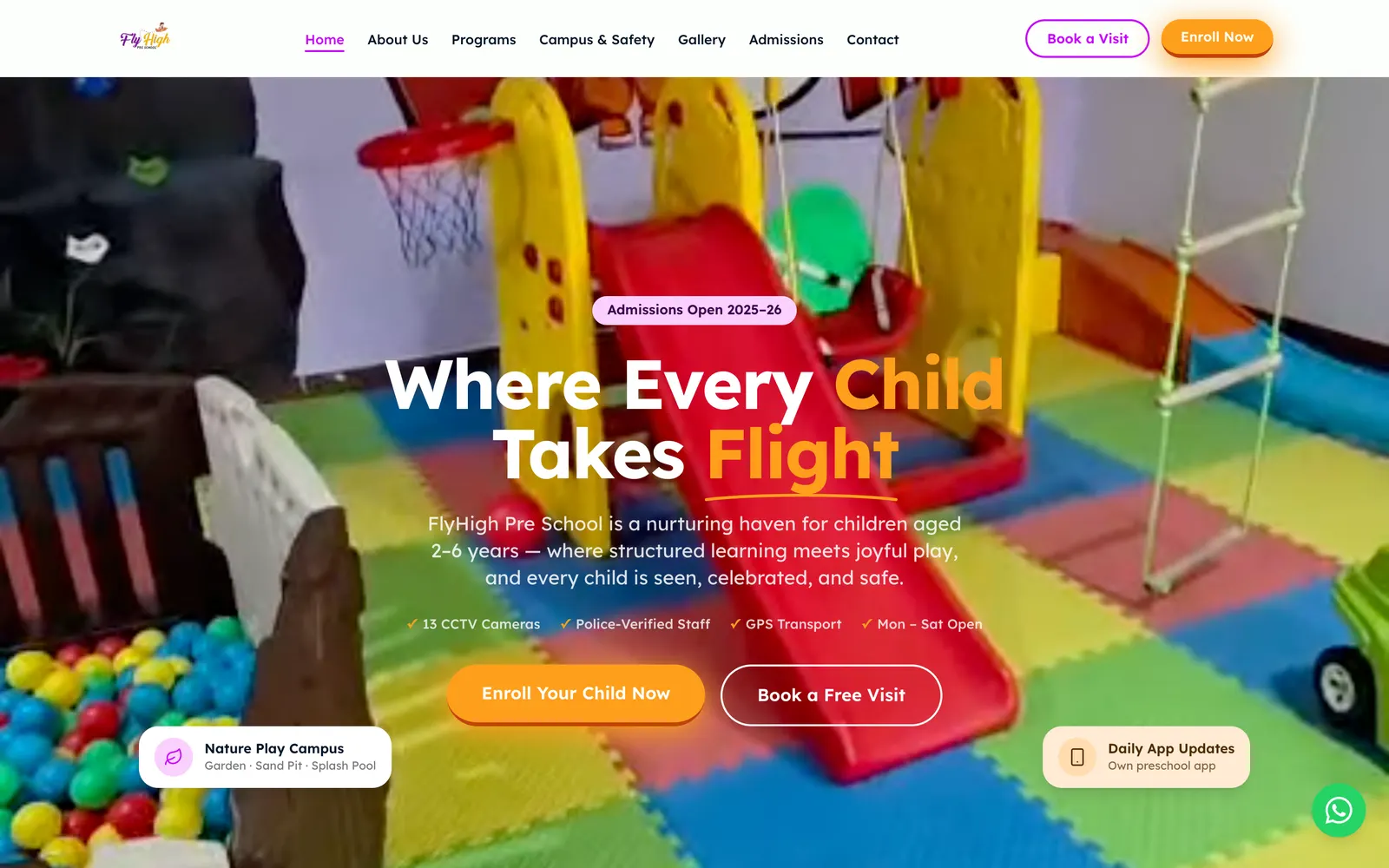
At Spurt Studios the web design work is done by the founders themselves, with no account-manager layer between you and the person building. We built the FlyHigh Pre School website that way, and the cbee pet social app on Google Play. Those two projects needed different skills, which is the point: a preschool website and an app with a backend are not the same job.
What should you ask a freelancer?
Beyond the usual portfolio questions, these matter more for a one-person provider:
- What happens if you are unavailable for a few weeks? Is there someone who can step in, and are the files somewhere I can reach?
- Which parts will you do yourself, and which will you hand to others? Copywriting, photography, hosting setup and search setup are the usual ones.
- Where will the work live? The domain, hosting and analytics should be in your name from day one.
- What do I receive at the end? Source files, logins, a short walkthrough and a list of every third-party tool used.
- How do changes work after launch? Per request, a monthly arrangement or a new quote?
What should you ask an agency or studio?
The questions change when the provider is larger:
- Who exactly will design and build my site, and can I speak to them?
- Is any of the work subcontracted, and to whom?
- Is the design custom, or based on a theme? If a theme, who holds the licence?
- Who is my day-to-day contact, and what happens if they leave?
- What is in the quote, and what is not? Content, photography, search setup, renewals and training are common gaps.
- How is the work documented so another developer could pick it up?
Good answers are specific. If a question gets a general answer about "our process", ask for an example from a recent project.
What matters whichever you choose?
Some points do not depend on the size of the provider:
- Live work you can test. Open their sites on your phone, on mobile data. Do pages load quickly? Do the forms work? Does the WhatsApp button open a chat?
- A written scope. Pages, features, content, revisions and what is excluded.
- Your accounts. Domain, hosting and analytics registered to your business, with your email address.
- A real handover. Logins, a walkthrough and clear options for ongoing updates.
- No guarantees about rankings. Nobody can promise a number-one position on Google.
- A line-by-line quote. Compare against the same brief, including renewal prices.
Our breakdown of what a website costs in Bangalore shows which line items usually move a quote, and our posts on maintenance and running costs cover what you pay after launch.
How should you decide in practice?
Write a one-page brief: the pages you think you need, who your customers are, how they should contact you, what content exists, and what you want to be able to edit yourself. Send the same brief to one freelancer and one or two studios. Ask each for a written, line-by-line quote and for two live sites to open on your phone. Then speak to the person who would do the work.
You will usually learn most from how they respond. A provider who asks sharp questions about your customers and how they enquire, before talking about design, is thinking about your business rather than about a template. That matters more than whether they call themselves a freelancer, a studio or an agency.
If you would like to put us through these questions, send us your brief and ask us anything on this list.