Short answer A manufacturer's website brings RFQs when a buyer can confirm fit without calling: what you make, sizes and capacities, materials, the file formats you accept, where you are, and a quote form that asks for quantity and drawings. IndiaMART brings volume, but the same BuyLead can go to six suppliers. Use both, and let your site win the comparison.
We've built websites for manufacturers: a plastic injection moulding die maker, a laser marking workshop, a groundwater-detector distributor and a gas-mixing equipment distributor. Their buyers differ, but all of them want enough detail to decide whether to send you the job. Here's what that detail is, how to structure it, and where IndiaMART fits.
What does a buyer need to see before sending an RFQ?
A purchase engineer or factory owner comparing suppliers is checking fit. The website should answer these without a phone call:
- Process: what you actually do (moulding dies, deep engraving, CNC, fabrication).
- Capacity: biggest part, heaviest part, batch sizes.
- Materials: what you work with, and what you don't.
- Inputs: which drawing and file formats you accept.
- Proof: photos of real parts you've made, not stock images of machines.
- Location and delivery: where you are and where you ship.
- How to quote: what to send you, and how fast you respond.
Two of our builds show how concrete this can be. On the one-page site we built for Sunrise Laser Markings, a laser marking and engraving workshop on Magadi Main Road in Bengaluru, the capabilities section states the maximum job size (500 × 500 mm), the approximate part weight they can take (150–200 kg), the area marked in a single setup (300 × 300 mm), and the artwork formats accepted: AutoCAD, DWG, DXF, CorelDRAW, JPEG, TIFF, BMP and PSD. A tool-room buyer can rule the workshop in or out in ten seconds.
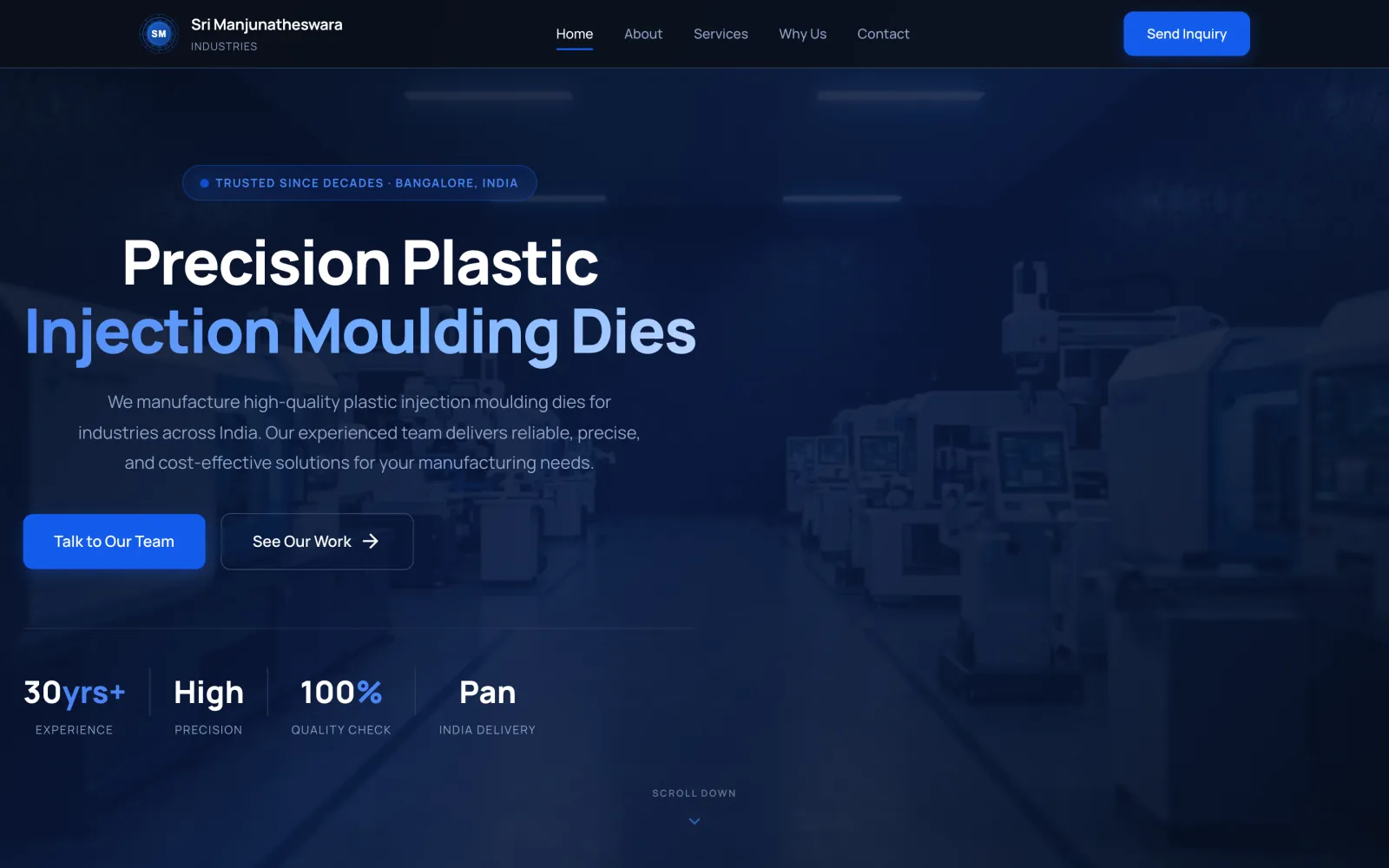
For Sri Manjunatheswara Industries, which makes plastic injection moulding dies in Bengaluru, the site sets out three services in tabs (custom injection moulding dies, die and tool making, design and development), lists the tool steels they work with (P20, C45, EN19 and OHNS), and shows a gallery of household and industrial plastic products made with their dies. That last part matters: a buyer sees the kind of part they need, not just a machine.
How should a manufacturer structure a product catalogue?
If you sell products rather than a process, give each product or product family its own page. One long "Products" page can't rank for twenty items, and a buyer can't share a link to the one they want.
A good product page carries a short plain-language description, the key specifications in a table, photos or video of the product in use, the datasheet or manual, related products, and an enquiry button that knows which product the buyer was looking at.
Two builds show variations:
- Siddhani Enterprises sells and supports groundwater-detection instruments in the Max range. Their site has a page per instrument with a key-specifications table taken from the printed catalogue and manuals. We didn't add a spec the manufacturer hadn't published. The same specs are also in the page's structured data, so they're machine-readable. A separate legacy-brands page lists older detector lines they still support with service and spares, which catches owners searching for model names that are no longer sold. The training page has the user manuals as a page-turning flipbook with a download option.
- AlyTech Scientific, a distributor of gas mixing and calibration systems based in Abu Dhabi, got a rebuild with a page per product, six industry pages (oil and gas, petrochemical, pharmaceutical, environmental, food and beverage, research) and a resources section listing datasheets, brochures, application notes and manuals. All of them are on request, which turns a download into a conversation.
Industry pages work when your buyers search by application ("gas mixer for emissions monitoring") rather than by product name.
Should spec sheets be PDFs or web pages?
Both, doing different jobs.
Put the key specs in HTML on the product page. A buyer on a phone can read a table; a PDF means pinching and zooming. Search engines read the table as text on the same page as your product name, location and enquiry button.
Offer the full datasheet as a PDF. Procurement teams file PDFs, attach them to purchase requests and print them. Google does index PDFs; it lists them among the file types it can index. But a PDF can't carry your quote form, and a buyer who lands on it from search may never see your site.
Decide deliberately whether datasheets are open or gated. Open datasheets help buyers shortlist you without contact. Request-only datasheets, as on the AlyTech build, give you a lead and a reason to call. For a niche distributor with a few high-value products, gating can make sense. For a job shop, open is usually better.
What should a manufacturer's RFQ form ask for?
Ask for what you need to quote, and nothing else. A useful starting set:
- Company name and contact person
- Phone and email
- Product or process required
- Quantity or batch size
- Material or grade
- Drawings, or at least the file format
- Target date and delivery location, if lead time matters
The right length depends on who's buying. Sunrise's WhatsApp button opens a pre-filled message with blanks for material and part quantity, so the first message already contains what the workshop needs to reply. Whatever form you use, send yourself a test enquiry every month. A form that looks fine but never delivers is worse than no form.
AlyTech's quote form is longer and more technical, because its buyers are lab and plant engineers. It pre-selects the product the visitor came from and asks for the gases and concentrations required and the relevant standards. Siddhani goes the other way. Its buyers are mostly borewell drillers, contractors and farmers who would rather talk than type, so at the client's request its callback form asks for just three things: name, city and mobile number, with call and WhatsApp buttons alongside. Both are right for their buyers. We go deeper on form length in what makes a small-business website turn visitors into enquiries.
IndiaMART vs your own website: which brings better RFQs?
IndiaMART is large. On its earnings call for the quarter ending March 2026, the company reported about 27 million unique business enquiries in that quarter and about 2.2 lakh paying suppliers (IndiaMART Q4 FY26 earnings call transcript, 30 April 2026). If your buyers use it, you should be there.
But know how the enquiries work. A BuyLead is a buyer's requirement that IndiaMART shares with relevant suppliers. Its help centre says a BuyLead expires when it is purchased by the sixth supplier, or on the third day after it's posted (IndiaMART help: BuyLead expiry). So a BuyLead can reach you and five competitors at once. Paid listings cost money too: IndiaMART's price list shows its Mini Dynamic Catalog plan at ₹40,000 a year before taxes (IndiaMART MDC price list); its help centre page lists ₹35,000, so confirm the current figure with them.
| IndiaMART listing | Your own website | |
|---|---|---|
| Who finds you | Buyers already searching on IndiaMART | Buyers searching Google or AI assistants, plus anyone you send the link to |
| Competition on the page | Other suppliers alongside you | Only you |
| Enquiry exclusivity | A BuyLead can be bought by up to six suppliers | Direct enquiries come only to you |
| Cost model | Yearly plan, plus BuyLead credits | Build cost plus small yearly hosting and domain fees |
| Control over presentation | Marketplace template | Full: specs, photos, industries, case examples |
| Time to first enquiry | Fast once listed | Slower; builds up as pages get indexed and shared |
The practical answer is both. Use IndiaMART for reach. Use your website as the place a serious buyer goes to check you out before sending drawings, and put its link on your quotations, visiting cards and email signature.
How do manufacturers get found beyond IndiaMART?
Three things do most of the work:
- A Google Business Profile that matches your website. Google's guidelines say your business name should reflect "your business's real-world name, as used consistently on your storefront, website, stationery, and as known to customers" (Google Business Profile guidelines). Use the same name, address and phone on your site, your profile and your IndiaMART listing.
- Pages that match what buyers type. "Injection moulding die maker Bengaluru", a model name, a process plus a material. One page per product or service gives each of these a place to land.
- Plain, crawlable text. Google says "structured data isn't required for generative AI search, and there's no special schema.org markup you need to add" (Google Search Central). We still add structured data, as on Siddhani's product pages, but the specs, capacities and location written clearly on the page matter more.
Manufacturer website checklist
| Item | Why it matters |
|---|---|
| One-line statement of what you make, on the first screen | Buyers decide fast whether to keep reading |
| Capacities, sizes and tolerances in numbers | Rules you in or out without a call |
| Materials you work with | Saves a wasted enquiry on both sides |
| Accepted drawing and file formats | Tells the buyer what to send |
| Real photos of parts and work | The strongest proof you have |
| A page per product or service | Each can rank and be shared |
| Specs in HTML, datasheets as PDF | Readable on phones and searchable |
| RFQ form sized to your buyer, plus call and WhatsApp | Captures the enquiry in the buyer's preferred channel |
| Address, map and delivery areas | Local buyers and logistics questions |
| Same name, address and phone on site, Google and IndiaMART | Consistent details across listings |
We build these from Chandra Layout, Bengaluru. See our work for manufacturers, or how we approach web design, web development and SEO.
Sources
- IndiaMART: Q4 FY26 earnings call transcript (call held 30 April 2026)
- IndiaMART help: Under what conditions does a BuyLead get expired?
- IndiaMART help: What is a BuyLead?
- IndiaMART: Mini Dynamic Catalog price list and help centre MDC page (checked 29 September 2026)
- Google Search Central: File types indexable by Google
- Google Search Central: Optimizing for generative AI search
- Google Business Profile: Guidelines for representing your business